Botany


Photo:

Red cedar

Thuja plicata with pollen cones

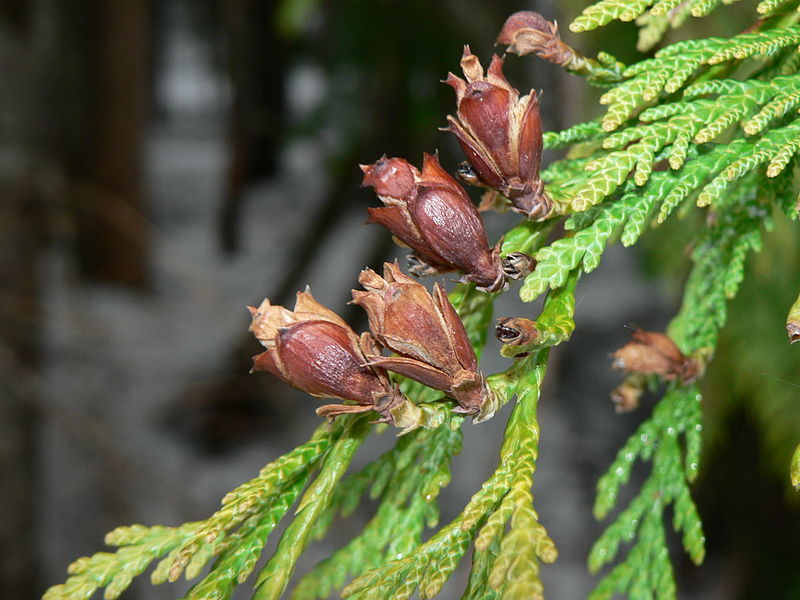
Red cedar

Thuja plicata with mature seed cones

Scientific Name:

Thuja plicata

Common Names:

Western Redcedar, Pacific Redcedar, Giant Arborvitae, Western Arborvitae, Giant Cedar, Shinglewood

Traditional Names:


Family:

Cupressaceae


Characteristics:

  • Western redcedar is a large evergreen coniferous tree, ranging up to 65 to 70 m tall and 3 to 7 m in trunk diameter. Trees growing in the open may have a crown that reaches the ground, whereas trees densely spaced together will exhibit a crown only at the top, where light can reach the leaves. It is long-lived; some individuals can live well over a thousand years, with the oldest verified being 1460 years.
  • The foliage forms flat sprays with scale-like leaves in opposite pairs, with successive pairs at 90 degrees to each other. The foliage sprays are green above and green marked with whitish stomatal bands below; they are strongly aromatic, with a scent reminiscent of pineapple when crushed.
  • The flowers are monoecious. The male flowers are arranged in small, terminal catkins and the female flowers are cones. The cones are small with thin, overlapping scales. They are green to yellow-green, ripening to brown in the fall about six months after pollination, and open at maturity to shed their seeds. The seeds are small, with a narrow papery wing down each side. The pollen cones are red or purple at first, and shed yellow pollen in spring.


Habitat:

  • Western redcedar is among the most widespread trees in the Pacific Northwest. It is associated with Douglas-fir and western hemlock in most places where it grows.
  • It is found over an elevation range from sea level to a maximum of 2,290 m above sea level.
  • In addition to growing in lush forests and on mountainsides, western redcedar is also a riparian tree, growing in many forested swamps and streambanks in its range.
  • The tree is shade-tolerant and able to reproduce under dense shade.


Medicinal


Parts Used:

  • The medicinal parts are the oil extracted from the leaves and branch tips, the young dried branches, the fresh, leafy annual branches and the fresh, leafy branches collected in spring (Gruenwald et al. 2000).


Collection and Harvesting:

  • The branch tips and young shoots of western redcedar are harvested in the summer/fall from young trees when the oil content and active agents are highest (Moore 1993). The branches should be dried in the shade and handled with care (Gruenwald et al. 2000).


Constituents:

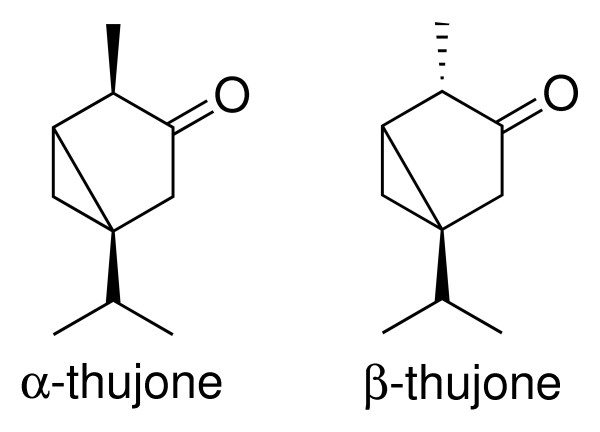
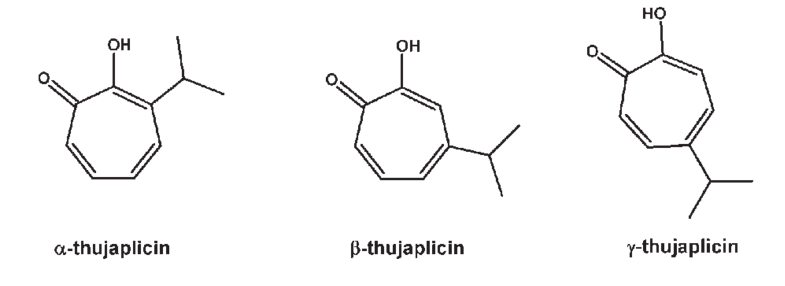
  • The constituents of western redcedar are plicatic acid, mearnsitrin (a flavonolglycoside), procyanidins, prodelphinidin, umbelliferon, p-coumaric acid, myricetin, quercetin, kaempferol-3-0-a-rhamnoside, catechin, and gallocatechin. The volatile oil from the leaves of contain, amongst other compounds, α-thujone, β-thujone, fenchone, sabinene, terpinen-4-ol, beyerene, α-pinene, and umbelliferone. The oil from the heartwood contains 1,4-cineole, fenchol, γ-eudesmol, thujic acid and α-, β- and γ-thujaplicin.
    • thujone
    • thujaplicin


Actions:

  • Western redcedar has antifungal (β-thujaplicin, γ-thujaplicin), antimicrobial (β-thujaplicin), antiviral (β-thujaplicin), stimulating, expectorant, immunostimulating, emmenagogue, and antispasmodic properties.
  • Thuja polysaccharides (TPS) have been shown to inhibit human immunonodeficiency virus (HIV)-dependent cell death.
  • Thujone has antinociceptive, insecticidal and anthelmintic activity.


Indications: (Moore 1993)

  • The tincture is used for various tineas, such as tinea versicolor, athlete's foot, ringworm, jock itch, and nail fungi. A glycerin tincture is better for application to tender tissues. Tincture should be applied consistently two or three times a day.
  • For chronic vaginitis and long, sluggish menses, use an infusion for a douche (alternating days) and take some of the tea (also on alternate days).
  • The tincture or tea acts as a stimulant to many smooth muscles, and this can be used in respiratory, urinary tract, and reproductive problems.
  • For chronic, mucus-heavy bronchial conditions, the tea is useful, but the best remedy is to put a teaspoon of the tincture into some simmering water and inhale the steam. Simmering some herb or inhaling the scent from a cotton ball impregnated with the alcoholic tincture may also be effective.
  • The cold infusion, taken internally, is effective for improving menstrual flow and reducing vaginal irritation in women. In men, it can be used for reducing an enlarged prostate, pain on urination or ejaculation, and periodic mucus in the urine.
  • Redcedar stimulates the vascular capillary beds, causing expansion and contraction, and heating and cooling, thus making it useful for chronic bladder and urethral irritability. For these conditions use the cold infusion twice a day.
  • Redcedar is an immunostimulant, increasing phagocytosis by granulocytes. Small, daily doses (in the absence of kidney disorders or pregnancy) can increase resistance to chronic respiratory and intestinal infections.


Combinations:

  • Western redcedar can be combined with small amounts of California Snakeroot and Astragalus to broaden the type of responses, and Devil's Club and Oregon Grape to increase the catabolism of metabolites produced by the immunologic stimulus (Moore 1993).
  • Combine with Echinacea and Baptisia for sinusitis.


Preparation and Dosage: (Moore 1993)

  • Alcohol tincture (fresh herb): 1:2 (herb:95% ethanol, by weight)
  • Glycerin tincture (fresh herb): 1:2 (herb:menstruum, by weight); menstruum is 50% glycerin, 40% water, 10% alcohol
  • Cold infusion: 1 part herb (by weight) to 32 parts water; dosage is 2 to 3 fluid ounces
  • Typical tincture dosage: 1.5 – 3.0 ml per day of 1:5 tincture or 10-20 ml per week


Contraindications:

  • Redcedar is not for extended use by those with kidney problems.
  • Because it stimulates uterine contractions, pregnant women should not use red cedar externally, internally, or in aromatherapy.
  • Red cedar can be highly immunogenic, and allergies to the tree's oils, extracts, tinctures, salves, infusions, and decoctions are fairly common. Skin irritation caused by red cedar oil can be reminiscent of poison ivy dermatitis.
  • Redcedar contains the neurotoxin thujone. Thujone is a monoterpene and a ketone that is used as an active ingredient in some cold medicines like nasal decongestants and cough suppressants. However, over-consumption of thujone can lead to side effects such as nervous agitation, chronic convulsions, renal and liver toxicity, brain toxicity, epileptic seizures, vertigo, and anxiety. Thujone is reported to be the toxic agent in absinthe, a liqueur popular in the 19th and early 20th centuries.


Drug Interactions:

  • Do not take Thuja with medication that increases the chance of having a seizure. Some medications that increase the chance of having a seizure include anesthesia (propofol, others), antiarrhythmics (mexiletine), antibiotics (amphotericin, penicillin, cephalosporins, imipenem), antidepressants (bupropion, others), antihistamines (cyproheptadine, others), immunosuppressants (cyclosporine), narcotics (fentanyl, others), stimulants (methylphenidate), theophylline, and others.
  • By affecting chemicals in the brain, Thuja may decrease the effectiveness of medications used to prevent seizures. Some medications used to prevent seizures include phenobarbital, primidone (Mysoline), valproic acid (Depakene), gabapentin (Neurontin), carbamazepine (Tegretol), phenytoin (Dilantin), and others.


Additional


History and Origin:

  • Cedar is native to North America, and was once used by the Native Americans to create canoes, earning it the title "Canoewood". It was later affectionately nicknamed 'Arbor Vitae', a French term for Tree of Life, after supposedly curing one of Jacques Cartier's men of scurvy during a 16th century expedition. As a result, cedar was imported to Europe for its beneficial properties, but now is primarily viewed as an ornamental tree (Mountain Rose Herbs 2015).


Ethnobotany:

  • Western redcedar is seldom, if ever, used in modern herbalism. It was employed medicinally by a number of native North American Indian tribes, who used it to treat a wide range of complaints (Moerman 1998):
    • An infusion of the leaves has been used in the treatment of stomach pains and diarrhoea.
    • A decoction of the leaves has been used in the treatment of colds.
    • A decoction of the powdered leaves has been used externally to treat various internal pains, including rheumatism.
    • The leaf buds have been chewed in the treatment of toothaches and sore lungs.
    • A decoction of the buds has been used as a gargle.
    • A decoction of the small branches has been used in the treatment of coughs, colds and tuberculosis.
    • A weak infusion has been drunk in the treatment of painful joints caused by rheumatism or arthritis.
    • A poultice of the crushed bough tips and oil has been applied to the back and chest in the treatment of bronchitis, rheumatism, stomach pains and swollen neck.
    • An infusion of the twigs has been used as a wash in the treatment of venereal disease sores.
    • A decoction of the boughs has been used as an antidandruff shampoo.
    • A decoction of the stem tips and the roots has been used in the treatment of colds.
    • An infusion of the bark and twigs has been used in the treatment of kidney complaints.
    • An infusion of the seeds and twigs has been used in the treatment of fevers.
    • The chewed bark, or a decoction of the bark, has been drunk to induce menstruation.
    • A moxa of the inner bark has been used as a counter-irritant for the skin.
    • A poultice of the inner bark has been applied to carbuncles.
    • The bark has been pounded until it is as soft as cotton and then used to rub the face.
    • The very soft bark has been used to bind wounds and cover dressings.
    • The shredded bark has been used to cauterize sores and swellings.


Growing Information:

  • Seeds are best sown when ripe in the autumn in a cold frame.
  • Stored seed germinates best if given a short cold stratification. This can be done by sowing them in a cold frame in late winter.
  • When the seedlings are large enough to handle, prick them out into individual pots and grow them on in the greenhouse for their first winter.
  • Plant the young trees out into their permanent positions in late spring or early summer, after the last expected frosts.
  • If growing large quantities of plants, the seed can be sown in an outdoor seed bed in mid spring. Grow the plants on for two years and then plant them out into their permanent positions in late autumn or early spring.


Personal Impressions and Experiences:

  • Western redcedar is a common forest tree in Port Neville Inlet.


Historical Botanical Illustrations:

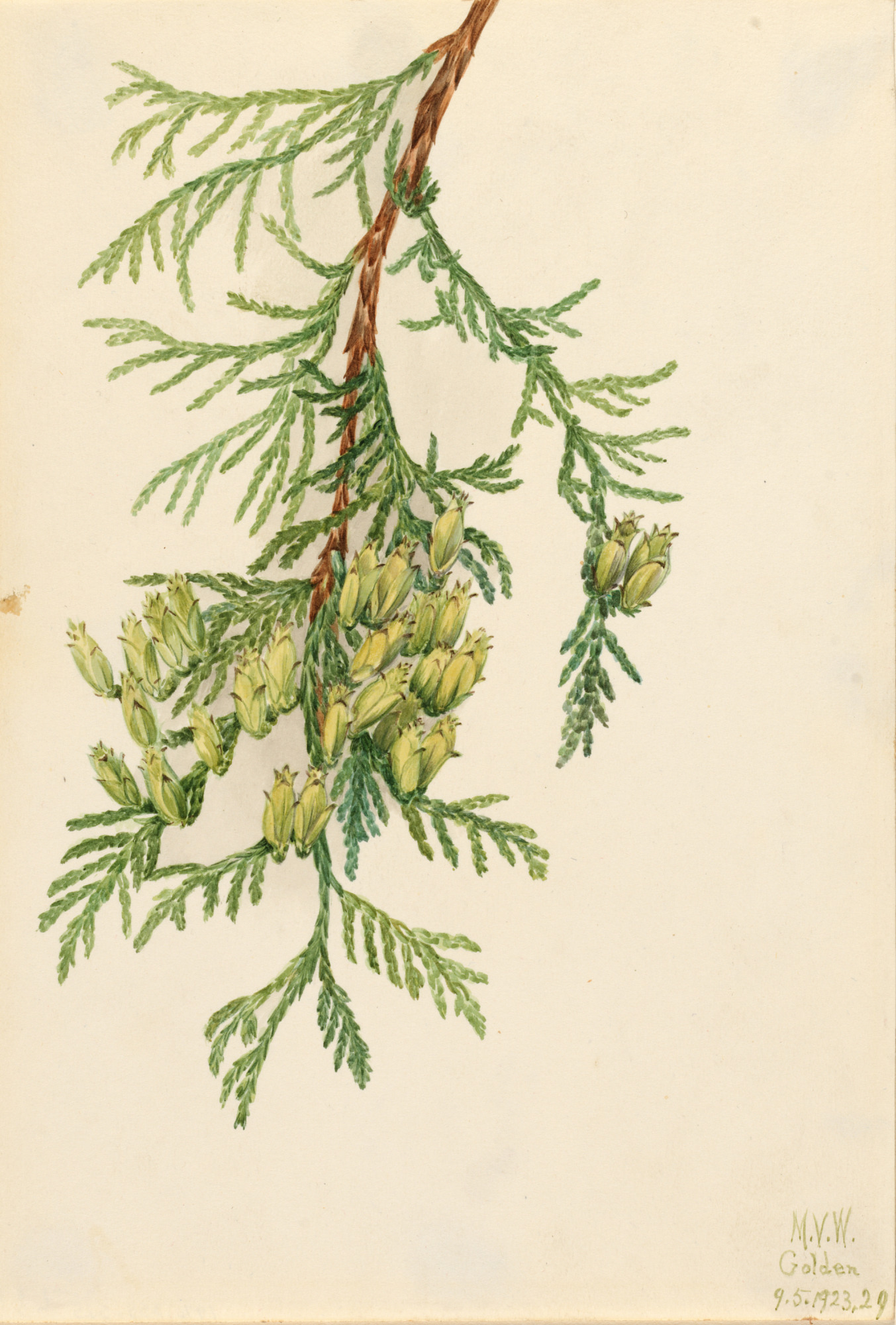
Thuja plicata


Thuja plicata, painting by Mary Vaux Walcott, 1923.