Botany


Photo:

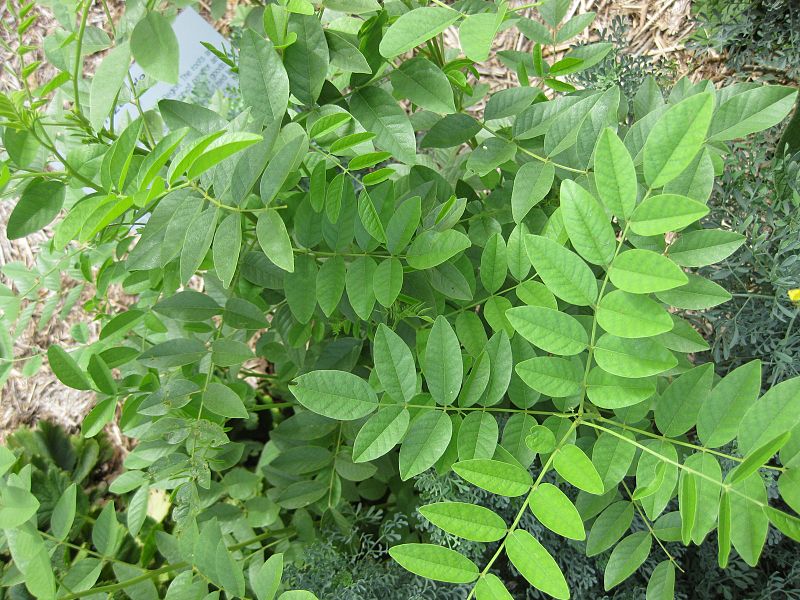
Licorice leaves


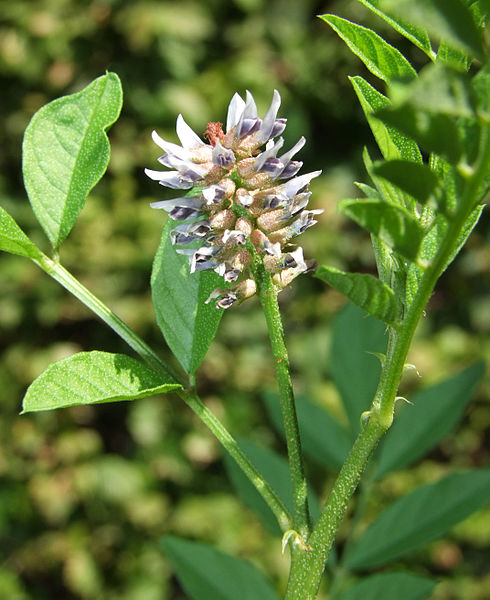
Licorice flowers


Scientific Name:

Glycyrrhiza glabra

Common Names:

Licorice, Liquorice, Sweet Root, Sweet Wort

Traditional Names:


Family:

Fabaceae


Characteristics:

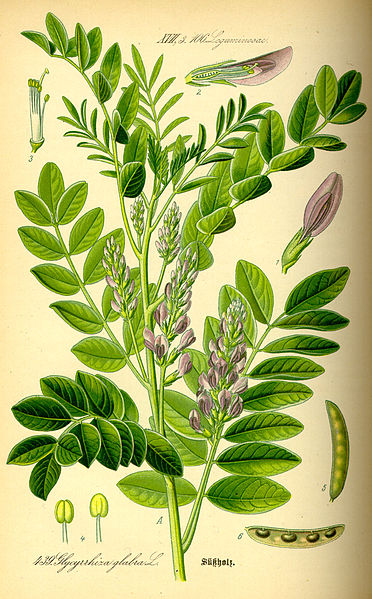
  • The inflorescences of licorice are axillary, upright, spike-like, and about and 10 to 15 cm long. The individual pea-like flowers are small, bluish to pale violet and short-pedicled. The unfused petals are narrow and pointed. The fruit is a pod, with 3 to 5 brown, kidney-shaped seeds (Gruenwald et al. 2000).
  • Licorice is a herbaceous perennial. It is 1 to 2 m high, and has a long sturdy primary taproot. There are several horizontal woody stolons which may reach 8 m. New stems are produced every year. The leaves are alternate, odd pinnate with 3 to 8 pairs of leaflets. The stipules are very small and drooping (Gruenwald et al. 2000).


Habitat:

  • Glycyrrhiza glabra is native to the Mediterranean and is cultivated in many other countries.
  • Individual varieties of Glycyrrhiza are found in different regions. Glycyrrhiza glanulifera is found in southeastern Europe and western Asia. Glycyrrhiza pallida and violocea are found in Iraq. Glycyrrhiza typica is indigenous to southern Europe and southwest Asia (Gruenwald et al. 2000).
  • Licorice is a tender perennial that is hardy in Zones 7 to 10. It prefers hot weather and full sun or partial shade (Gladstar 2012).


Medicinal


Parts Used:

  • Licorice root consists of the peeled or unpeeled, dried roots and stolons of Glycyrrhiza glabra (Gruenwald et al. 2000).


Collection and Harvesting:

  • Licorice needs a few years of growth to develop its full medicinal potential. Harvest the roots in the fall of the third or fourth year. After the fourth year, the roots tend to become woody and tough. Slice or chop the fresh roots, dry them, and store in an airtight glass jar (Gladstar 2012).


Constituents:

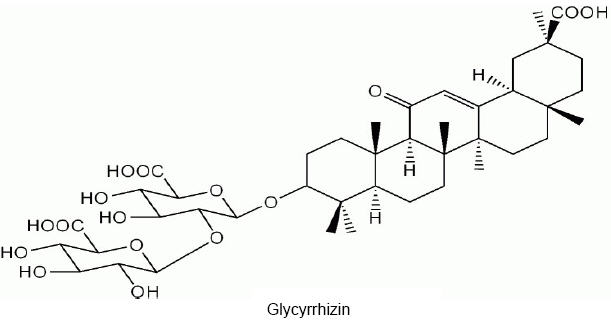
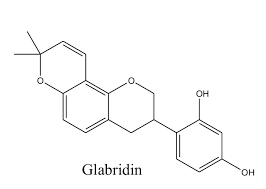
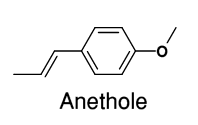
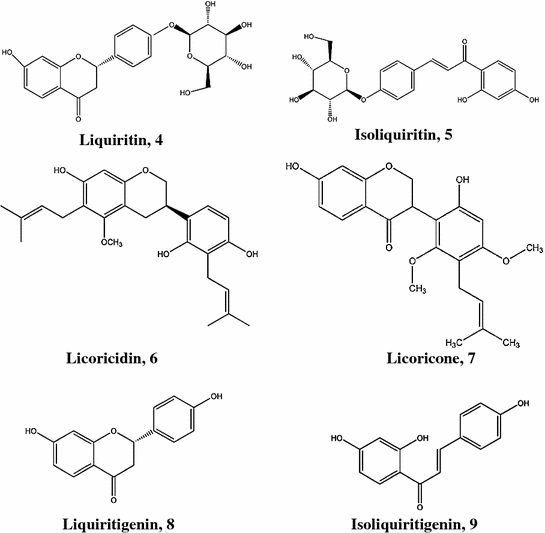
  • Licorice contains glycyrrhizic acid (also known as glycyrrhic acid; is responsible for the sweet taste; salts are called glycyrrizin), steroids (beta-sitosterol, stigmasterol), coumarins (glycyrol, isoglycyrol, liqcoumarin, herniarin, umbelliferone, glycycoumarin, licopyranocumarin), flavonoids (liquiritigenin, isoliquiritigenin, isolicoflavonol, formononetin, glabrene, glabridin, glabrol, 3-hydroxyglabroI, glycyrrhisoflavone), essential oils (anethole, estragole, eugenol, hexanoic acid), and polysaccharides (Gruenwald et al. 2000; Gladstar 2012).
  • Much of the sweetness in licorice comes from glycyrrhizin, which has a sweetness that is 30–50 times that of sugar. The sweetness is very different from sugar, being less instant, tart, and lasting longer.
  • The scent of licorice root comes from a complex and variable combination of compounds, of which anethole is up to 3% of total volatiles.
  • The isoflavene glabrene and the isoflavane glabridin are phytoestrogens.
    • glycyrrhizin
    • glabrene

      Glabrene

    • glabrin
    • anethole


Actions:

  • Licorice has the following actions (Buhner 2012; Gruenwald et al. 2000; Hoffman 2003):
    • Expectorant
    • Demulcent
    • Anti-inflammatory/Antiplatelet - glabridin exerts anti-inflammatory effects through inhibition of tyrosinase activity, superoxide anion production, and cyclooxygenase activity; licoricidin, a potent compound in the root, has an inhibitory effect on isoPAF (platelet-activating factor) acetyltransferase resulting in anti-inflammatory activity; isoliquiritigenin, an aldose reductase inhibitor, exerts anti-platelet effects through inhibition of cyclooxygenase, lipoxygenase, and peroxidase activity; glycyrrhizin has anti-thrombin action through inhibition of thrombin induced platelet aggregation, also resulting in anti-inflammatory effects.
    • Antiulcer - licorice has protective effects against gastric ulcers induced by aspirin as a result if its ability to release endogenous secretin, which is a potential mediator of the antiulcer actions.
    • Synergist - licorice is a potent synergist which is specifically useful in treating resistant Gram-negative infections:
      • It increases the action of other herbs and pharmaceuticals, and if added to a mixture prior to tincturing it will enhance the extraction.
      • It acts as a detoxicant.
      • It is an inhibitor of one of the main efflux mechanisms in Gram-negative bacteria.
    • Antiviral - glycyrrhizin prevents viral replication across a wide range of viruses, inhibits viral growth, inhibits neuraminidases in numerous influenza strains, inactivates virus particles, and inhibits chemokine secretion, thus preventing viral entry into permissive cells
    • Antifungal - glycyrrhizin improves resistance to yeast infections by modulating the inflammatory response; glabridin is antifungal.
    • Immunostimulant - licorice stimulates interferon production, enhances antibody formation, and stimulates phagocytosis.
    • Antihepatotoxic - glycyrrhizin inhibits hepatocyte injury caused by toxins.
    • Antispasmodic
    • Mild laxative


Indications:

  • Licorice is used internally for coughs, bronchitis, and gastritis (Gruenwald et al. 2000).
  • Unproven uses for licorice (Gruenwald et al. 2000):
    • Licorice was used for catarrh of the upper respiratory tract as well as for gastric/duodenal ulcers.
    • Licorice extract was used for gastritis, gastric ulcers, ulcer prophylaxis, and viral liver inflammation.
    • In folk medicine, licorice is used for appendicitis, constipation, to increase milk production and micturation, as a treatment for epilepsy, and for inflammation of the gastrointestinal and urogenital tract.
    • Externally, licorice was used for dermatoses.
  • In Indian medicine, licorice is used internally for gastric ulcers, headaches, bronchitis, eye diseases, and sore throat, and externally for wounds and cuts (Gruenwald et al. 2000).
  • In Chinese medicine, licorice is used for sore throats, carbuncles, spleen disorders, dry cough, and dehydration (Gruenwald et al. 2000).
  • Licorice tea and tincture are excellent for toning and strengthening the endocrine-gland system and are a specific remedy for adrenal exhaustion (Gladstar 2012).
  • Licorice is used as a synergist in systemic bacterial infections (Buhner 2012).


Combinations:

  • Licorice can be combined with cinnamon, Echinacea, marsh mallow root, and ginger to make a tea which strengthens the voice and soothes throat irritation (Gladstar 2008).
  • I combine licorice with Usnea, Echinacea, and cinnamon to make a potent (and tasty) tea which combats systematic infections.


Preparation and Dosage:

  • Tincture dosage is 1 to 3 ml three times a day (1:5 in 40%) (Hoffman 2003).
  • To make a decoction, put ½ to 1 teaspoon of root in 1 cup of water, bring to a boil, and simmer for 10 to 15 minutes. This should be drunk three times a day (Hoffman 2003).
  • Average daily dosage is 5 to 15 g root, equivalent to 200 to 600 mg of glycyrrhizin (Hoffman 2003). 
  • Licorice should not be taken for longer than 6 weeks (Gruenwald et al. 2000).


Contraindications:

  • Side effects are minimal if daily intake is less than 10 mg of glycyrrhizin. Chronic use may cause hypokalemia, headache, spastic numbness, hypertension, weak limbs, dizziness, and edema (Hoffman 2003).
  • Glycyrrhizin and glycyrrhetinic acid have antidiuretic, mineralocorticoid-type actions, but these constituents are removed from most commercial extracts. The resulting extracts are denoted as "deglycyrrhizinated" (Hoffman 2003).
  • Glycyrrhizic acid can cause sodium retention and potassium loss, resulting in stress to the heart and kidneys. Individuals with a history of high blood pressure, water retention, heart palpitations, and other signs of heart and/or kidney stress should use licorice only under the guidance of a qualified health-care practitioner (Gladstar 2012).
  • Licorice’s strong estrogenic activity will cause breast growth in men, especially when combined with other estrogenic herbs; however, these conditions abate within 2 to 4 weeks after licorice intake ceases (Buhner 2012).
  • Large doses of licorice taken long term during pregnancy may have detrimental effects on the unborn children. Low doses are apparently safe (Buhner 2012).


Drug Interactions:

  • Prolonged use in conjunction with thiazide and loop diuretics and cardiac glycosides is contraindicated, and licorice should not be administered in combination with spironolactone or amiloride (Hoffman 2003).
  • Licorice is not recommended for patients taking cardiac glycosides, hypotensive agents, corticoids, diuretic drugs, or monoamine oxidase inhibitors (Hoffman 2003).


Additional


History and Origin:

  • Glycyrrhiza glabra is native to the Mediterranean and is cultivated in many other countries. Other species of Glycyrrhiza are found in Europe, Asia, and Iraq (Gruenwald et al. 2000).
  • Licorice root is one of the most widely used medicinal herbs worldwide, and is the single most used herb in Chinese medicine today (Mountain Rose Herbs 2015).


Ethnobotany: (Mountain Rose Herbs 2015)

  • Licorice was used by the Egyptians as a flavoring for a drink called Mai-sus, and large quantities were found in the tomb of King Tut for his trip into the afterlife.
  • Pliny the Elder recommended it to clear the voice and alleviate thirst and hunger.
  • Dioscides, when traveling with Alexander the Great, recommended that his troops carry and use licorice to help with stamina for long marches, as well as for thirst in areas of drought.
  • In the Middle Ages, licorice was taken to alleviate the negative effects of highly spicy or overcooked food. It was also used for flavoring tobacco.
  • The first use of licorice in China dates back to the time of the great Chinese herbal master Zhang Zhong Zhing, about 190 AD, but it was certainly used for many centuries prior to this.


Growing Information: (Gladstar 2012)

  • Licorice is a tender perennial, hardy in Zones 7 to 10, but can survive down to Zone 3.
  • Licorice prefers hot weather and full sun or partial shade.
  • Licorice prefers a slightly sandy soil, with a pH between 6 and 8.
  • Like all members of the Fabaceae family, licorice "fixes" nitrogen in the soil.
  • Licorice seeds germinate well and quickly, and the plants grow to be quite large. Plants need to be spaced 1½ to 2 feet apart in a sunny spot in the garden. The soil needs to be kept moist until the seeds have germinated, and young plants are well established.
  • Licorice needs a few years of growth to develop its full medicinal potential.


Personal Impressions and Experiences:

  • My mother used to give me a piece of licorice root to chew on as a snack or hunger suppressant. I never liked the flavor of licorice candies, having grown up accustomed to the flavor of the actual licorice root, which tastes quite different.
  • I use licorice in teas regularly, both medicinally and for sweetening and flavor.
  • I have had some success growing licorice in our garden, but even in Zone 8a, licorice is susceptible to cold springs with late frosts. Wrapping or insulating the plants with straw may help.
  • Licorice seeds can be obtained from West Coast Seeds.


Historical Botanical Illustrations:

Licorice illustration


Glycyrrhiza glabra (licorice)