Botany


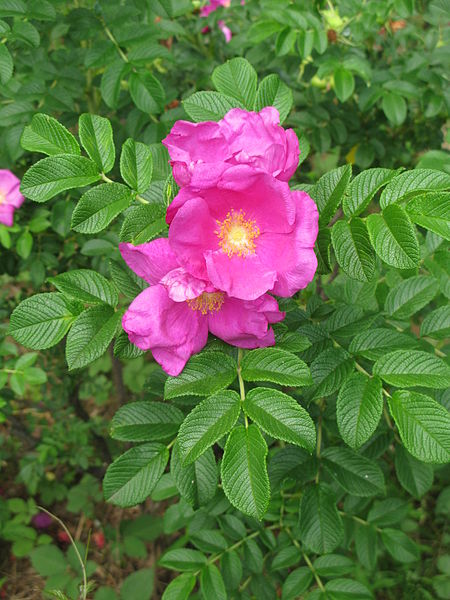
Photo:

Rose

©Wikipedia

Scientific Name:

Rosa sp. (e.g., Rosa canina, Rosa rugosa, Rosa nutkana [native species])

Common Names:

Rose (e.g., Dog Rose, Rugosa Rose, Nootka Rose [native species])

Traditional Names:


Family:

Rosaceae


Characteristics:

  • The pink flowers are usually solitary or in clusters of 2 or 3. The flowers have 5 sepals, 5 (or more) petals, and numerous stamens. The ovaries grow into stiff-haired nuts surrounded by the receptacle, which swells and becomes the scarlet "rosehip" (Gruenwald et al. 2000).
  • The plant is an approximately 1 to 3 m high shrub, with hanging branches and erect root shoots that are covered in tough, sickle-shaped prickles. The leaves are pinnatifid, with 5 to 7 leaflets. They are petiolate, ovate, and may be either smooth-margined or toothed (Gruenwald et al. 2000).


Habitat:

  • Roses are extensively cultivated world-wide (Gruenwald et al. 2000).
  • Our local native species occurs in a variety of generally open habitats (shorelines, meadows, thickets, streamside areas, roadsides, clearings) at low to middle elevations (Pojar & MacKinnon 1997).


Medicinal


Parts Used:

  • The petals, rose hips (with or without seeds), or leaves are used (Gladstar 2008; Gruenwald et al. 2000). Rosa canina is often cultivated for its rose hips, although some varieties of Rosa rugosa produce massive rose hips which are very good for jam and drying. Rosa gallica and Rosa centifolia are cultivated for their petals, which are used to produce rose oil (Gruenwald et al. 2000).


Collection and Harvesting:

  • Rose flowers are gathered prior to fully unfolding. The petals are harvested by hand and dried in the shade (Gruenwald et al. 2000).
  • The ripe rose hips are harvested by hand and dried in the air, sun, or in a drier at a maximum temperature of 80° C (Gruenwald et al. 2000). The seeds may be removed from the hips before drying (Gladstar 2008). This is easiest with rose species that produce very large hips. If the rose hips are small, it may be easier to cook the hips until they are soft, and then strain the seeds out. The strained hips can be used to make syrup, jam, or dried into fruit leather.


Constituents:

  • Fresh rose hips contain primarily pectins, fruit acids (malic acid, citric acid), oils, and tocopherol (vitamin E) (Gruenwald et al. 2000).
  • Dried rose hips have higher concentrations of many secondary metabolites, and contain carotinoids, flavonoids, tannins, and ascorbic acid (vitamin C), as well as fruit acids (malic acid, citric acid), sugars, and pectins (Gruenwald et al. 2000).
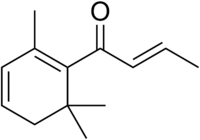
  • Rose petals contain tannins (specifically oligomeric proanthocyanidins) and volatile oils (chiefly (-)-citronellol, geraniol, nerol, phenyl ethanol, as well as (-)-linalool and citral) (Gruenwald et al. 2000). The distinctive "rose" scent of rose oil, however, is produced by beta-damascenone, beta-damascone, beta-ionone, and rose oxide. Beta-damascenone presence and quantity is considered as the marker for the quality of rose oil.
    • ascorbic acid
    • Ascorbic acid (vitamin C)

    • Beta-damascenone
    • Beta-damascenone


Actions:

  • Rose hips contain more vitamin C than almost any other herb, and many times the amount found in citrus fruit when measured gram by gram. Vitamin C is a noted antioxidant with disease-fighting abilities (Gladstar 2008). Vitamin C is frequently taken to combat the effects of colds. Rose hips are frequently use as a vitamin C supplement (Gruenwald et al. 2000). During my childhood, I remember making rose hip jam, which was valued not only for its flavor, but because of its high vitamin C content.
  • Rose leaves and hips are astringent and toning (Gladstar 2008). The astringent effect is attributed to the tannin content (Gruenwald et al. 2000).
  • The pectin and fruit acid content of rose hips (especially fresh hips) are responsible for their diuretic and laxative effects (Gruenwald et al. 2000).


Indications:

  • Rose flowers are used internally for inflammation of the mouth and pharynx (Gruenwald et al. 2000).
  • In India, rose flowers are used for coughs, bronchitis, asthma, fever and general debility. They are also used for wounds and hyperhydrosis (Gruenwald et al. 2000).
  • There are many unproven uses for rose flowers and rose hips (Gruenwald et al. 2000):
    • Rose flowers are used in folk medicine internally for diarrhea, tuberculosis of the lungs, pulmonary catarrh and asthma, hemorrhage and leucorrhea.
    • Externally, they are used for inflammations of the oral and pharyngeal mucosa, suppurating wounds and eyelid inflammation.
    • Rose fruits (hips with seeds) are used in folk medicine for disorders of the efferent urinary tract and the kidneys, kidney stones, rheumatic conditions such as rheumatism, and gout, colds, scurvy and febrile conditions.
    • Rose shells (dried hips with the seeds removed) are used in folk medicine for colds and flu, intestinal conditions, digestive complaints, vitamin C deficiency, gallstones, subacidic-stomach, infectious diseases, conditions of the efferent urinary tract, edema, rheumatism and gout, bleeding and leucorrhea.


Combinations:

  • Rose hips can be combined with chamomile, lemon balm, and borage flowers to make a tea which soothes irritated nerve endings and eases away the day’s tension (Gladstar 2008).
  • Rose hips mixed with apples make a delicious jam which is rich in vitamin C.


Preparation and Dosage: (Gruenwald et al. 2000)

  • Rose hip tea can be made by adding 2 to 5 g of dried or powdered rose hips to 1 (200 ml) cup of water and steeping for 10 to 15 minutes.
  • Rose petal tea can be made by adding 1 to 2 g of dried or powdered rose petals to 1 (200 ml) cup of water. Up to 3 cups of rose petal tea can be drank each day. The tea infusion can also be used for rinses and washes.
  • A single daily dose of dried or powdered rose hips is 2 g.
  • A single daily dose of dried or powdered rose petals in 5 to 10 g with honey or liquid.
  • Rose leaves can be applied directly to the eyes.
  • Rose vinegar can be made by adding 60 g of rose petals o 750 ml of red wine vinegar.


Contraindications:

  • N/A.


Drug Interactions:

  • N/A.


Additional


History and Origin:

  • Most rose species are native to Asia, with smaller numbers native to Europe, North America, and northwest Africa.
  • The birthplace of the cultivated rose was probably Northern Persia, on the Caspian, or Faristan on the Gulf of Persia. Thence it spread across Mesopotamia to Palestine and across Asia Minor to Greece. Greek colonists probably brought it to Southern Italy. It is likely that the Roses used in ancient days were cultivated varieties (Grieve 1998).
  • Pliny the Elder recorded thirty two different medicinal uses of roses in the first century.


Ethnobotany:

  • In Essex, England, records show that rose-hip syrup was used to treat colds and sore throats and crushed rose leaves were used to treat cuts (Allen & Hatfield 2004).
  • In Donegal, Ireland, the juice of a plant expressly named as rós has been a cough cure (Allen & Hatfield 2004).
  • Rosa rubiginosa, possibly a native species in some parts of Ireland, has been recorded from Longford, Ireland as taken as a decoction for jaundice (Allen & Hatfield 2004).
  • Rosa nutkana was used by First Nations groups in British Columbia for a variety of purposes (Pojar & MacKinnon 1997):
    • A decoction of the branches or strips of bark was used as an eyewash for cataracts or to enhance eyesight.
    • Mashed leaves were used as a poultice for sore eyes or absesses.
    • Chewed leaves were applied to bee stings.
    • Ripe rose hips were steeped, mashed, and fed to babies with diarrhea.


Growing Information:

  • Hardy species of roses, such as Rosa rugosa or native species are easy to grow:
    • Rosa rugosa and Rosa nutkana thrive in coastal conditions and are tolerant of sea spray and wind.
    • These species are winter hardy.
    • They do not require particular soil conditions, and in a site in the garden with 6 hours or more of direct sun, they will bloom abundantly.
  • Roses can be started vegetatively from canes, or from seeds, but the seeds will need to be stratified (a process by which seeds are artificially exposed to cold-moist conditions between layers of soil or peat to encourage subsequent germination in spring).


Personal Impressions and Experiences:

  • Native wild rose species have been a part of my childhood experiences. My mother and I would pick rose hips in the fall, and then make rose hip jam from them. In recent years, I have started to pick rose hips again. I either split them, remove the seeds, and dry them, or stew and strain them, and then mix them with apples to make apple-rose hip jam.
  • I love the scent of wild roses. I pick the petals and then make an infused oil from them. While milder than the essential rose oil that can be purchased, it still has a wonderful odor, and can be easily incorporated into salves.
  • Dried rose hips are a terrific addition to many teas.


Historical Botanical Illustrations:

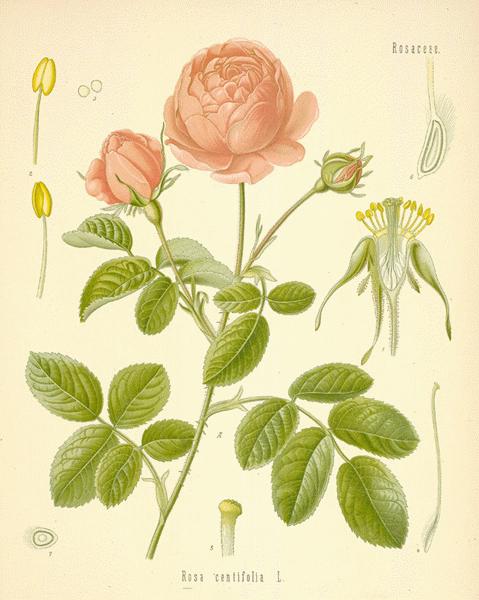
Rose illustrations


Rosa centifolia (cabbage rose) - A Modern Herbal by Mrs M. Grieve at http://botanical.com/botanical/mgmh/r/roses-18.html.