Spring and summer are always busy times on the homestead, and this year is no exception. Here’s a few vignettes describing our latest adventures.
New Sheds for the Homestead
When we first moved to the Inlet, we purchased a cheap metal shed and a large portable ShelterLogic tent from Canadian Tire to store our gear in while we were building the cabin. Over the last eleven years, those “temporary” storage solutions have become valuable dry spaces for stowing everything that couldn’t be crammed into the cabin. However, time has taken its toll on things that were not made to last. We replaced the floor in the metal shed a few years back, and bought a replacement cover for the ShelterLogic tent, but both of them are gradually reaching a point where they will no longer be repairable. It had become time to get some new sheds.
April began with finally getting our sheds (two of them). Wow! That was a project and a half.
The Problems:
-
- Firstly, the sheds were tough to get. We wanted “plastic” sheds because they are not subject to rot, carpenter ants, or termites, and last 20 years, which is longer than a wood shed will last out here. However, thanks to tariff wars, no one was currently importing them from the US, and, unfortunately, no one in Canada manufactures non-wood shed kits.
- Secondly, shed kits are big and heavy. The sheds we wanted are shipped on pallets, approximately 96” x 32” x 45” and weighing 750 lbs or so each. Even if we could find a supplier for the sheds who would ship them to Campbell River, they would be much too large to shove into our SUV. We had hoped to get our friendly delivery guy from Sayward to pick them up in Campbell River with his truck and trailer and bring them down to Sayward, but apparently his truck had bit the big one, and he couldn’t afford to replace it. From Sayward, the sheds would then need to be transported by boat to our home in Port Neville Inlet. We had originally hoped to get someone with a landing craft to transport the pallets to our homestead, but, in the end, that wasn’t possible either.
The Solutions:
-
- Luckily, Canadian Tire had some kits stockpiled in their Ontario storehouse. The sheds were shipped across Canada, and arrived in Saanich, on Vancouver Island. From there, Canadian Tire shipped them (for free) to their store in Campbell River.
- We found a fellow from Black Creek with a crane truck that could pick up both pallets and deliver them to the dock in Sayward.
- We ended up having to transport the shed kits from Sayward to Port Neville in our herring skiff. The old skiff was just barely large enough to fit the two pallets in, which is why we were hoping to find another method of transport. Ken had to build some extra supports to extend the central deck out over the bow and stern fish pens (we had always left these open for hauling large and awkward objects).
- That’s when the fun really began! We had to tow the skiff over to Kelsey Bay and arrange truck schedules with weather (which is always unscheduled) so that we could meet the truck, with its load of two sheds, at the wharf to transfer the load.
The Misadventure:
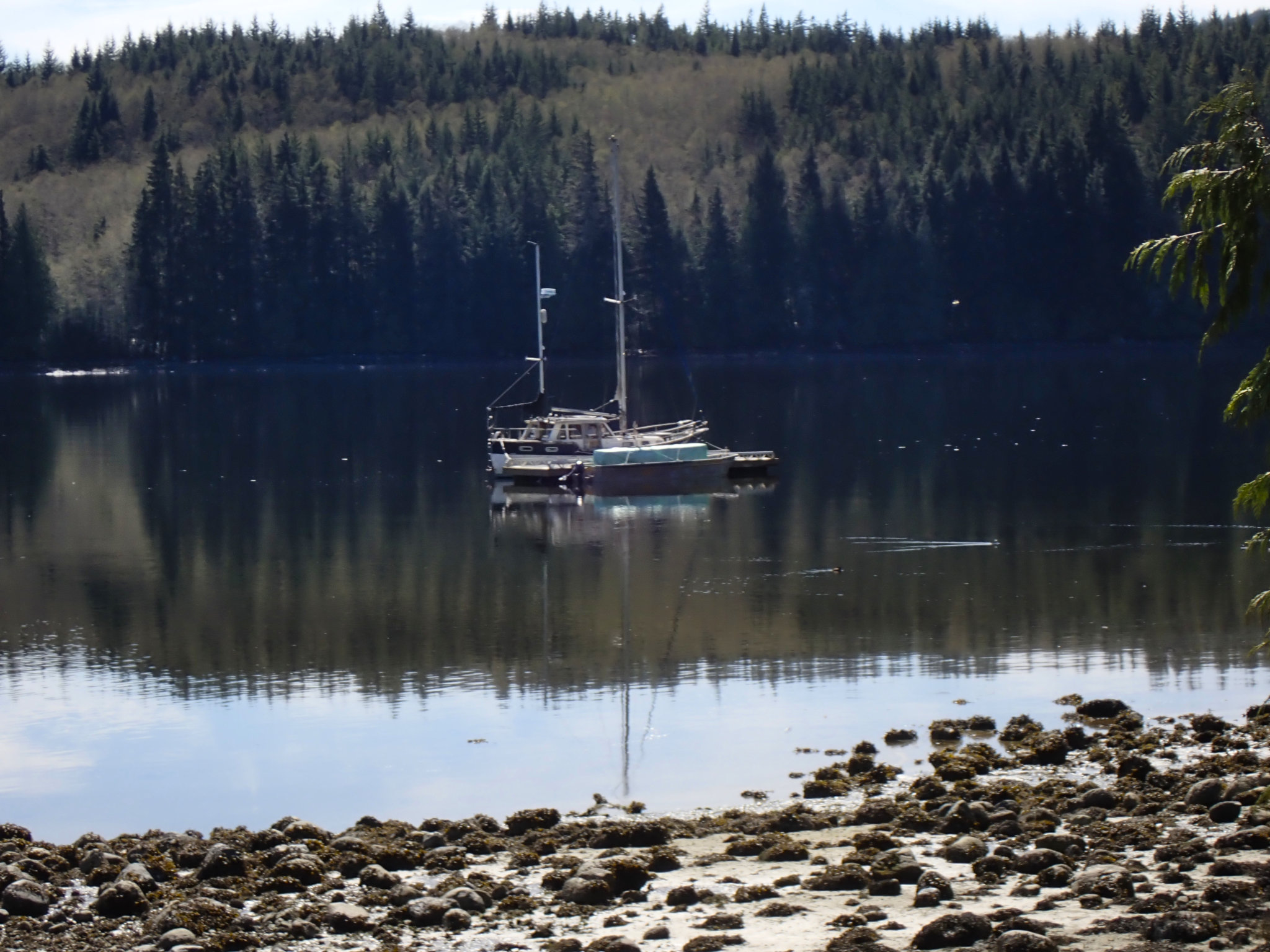
To complicate matters, on the day before we left, as we were tying the skiff up to the Awen and preparing everything for our journey, I managed to do the unexpected. I was standing on the bow of the herring skiff reaching out to grab the Awen’s railing and tie the skiff up, when suddenly the skiff jerked sideways. I’m still not sure how this happened. Where once there had been a deck plate under my feet, now there was air . I fell inboard rather than outboard. However, this wasn’t much of a blessing. As I was falling backward, I remembered that right behind me was the edge of the raised deck in the skiff. It’s amazing how long a fall like that can take—I had lots of time to think about smashing my back into a solid sharp edge of wood—enough time to twist slightly sideways and smash into my shoulder blade instead. Well, that saved my back, but at the expense of a cracked rib just under the edge of my shoulder blade. It was very painful for the first couple of weeks afterwards, and ultimately took several months to heal. However, in spite of my fall, the trip still had to go on, with everything so carefully planned and the weather in our favor!! I couldn’t use my right arm to lift anything, but we did manage to get the two pallets loaded on the herring skiff, as well as pick up all the lumber we needed to make the floor for the first shed.
Building a Shed:
Back home we came with a load! Unpacked the two sheds, and hauled them up from the beach (still only lifting with my left arm, which was getting quite the work out). Hauled all the wood up from the beach. Hauled everything else we’d gotten from town up the beach—this process never seems worthy of mention until one of us is partially broken. Then we temporarily packed the sheds away until we could get some more time to put them together.
Before we could assemble the first shed, we had to move the potato “patch”, as that location had been deemed the ideal spot for the new shed. This meant moving all my potato “barrels” to a new site, breaking sod, and levelling the ground … and so another week went by. Bouts of rain and wind slowed us down. Another issue was starting to loom on the horizon—we had stored one of the shed kits in the mostly empty woodshed, but the time was quicky coming for us to fill that woodshed with wood.
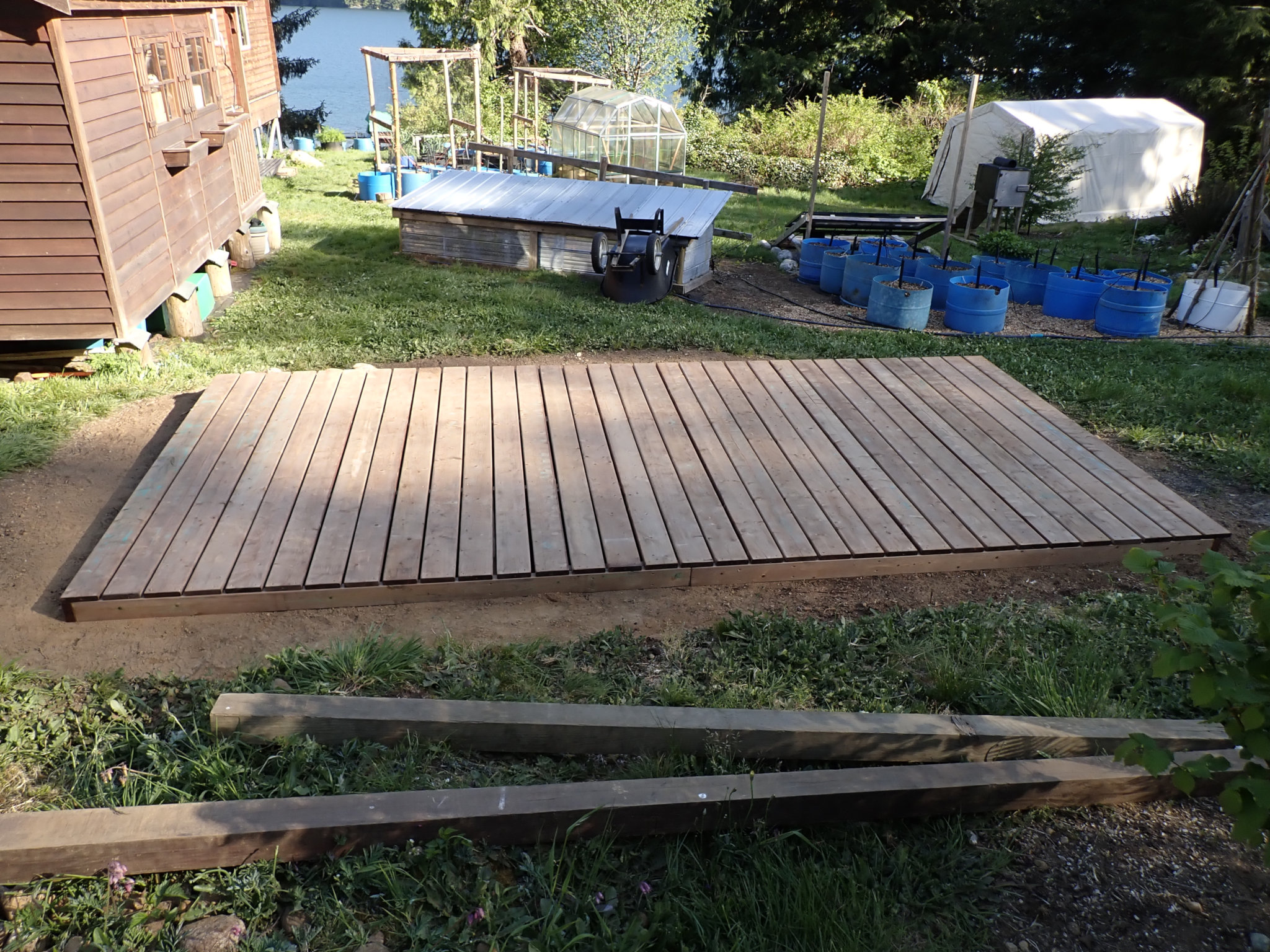
A sudden shift of the weather from wet to very hot made it possible for us to get the shed floor built.
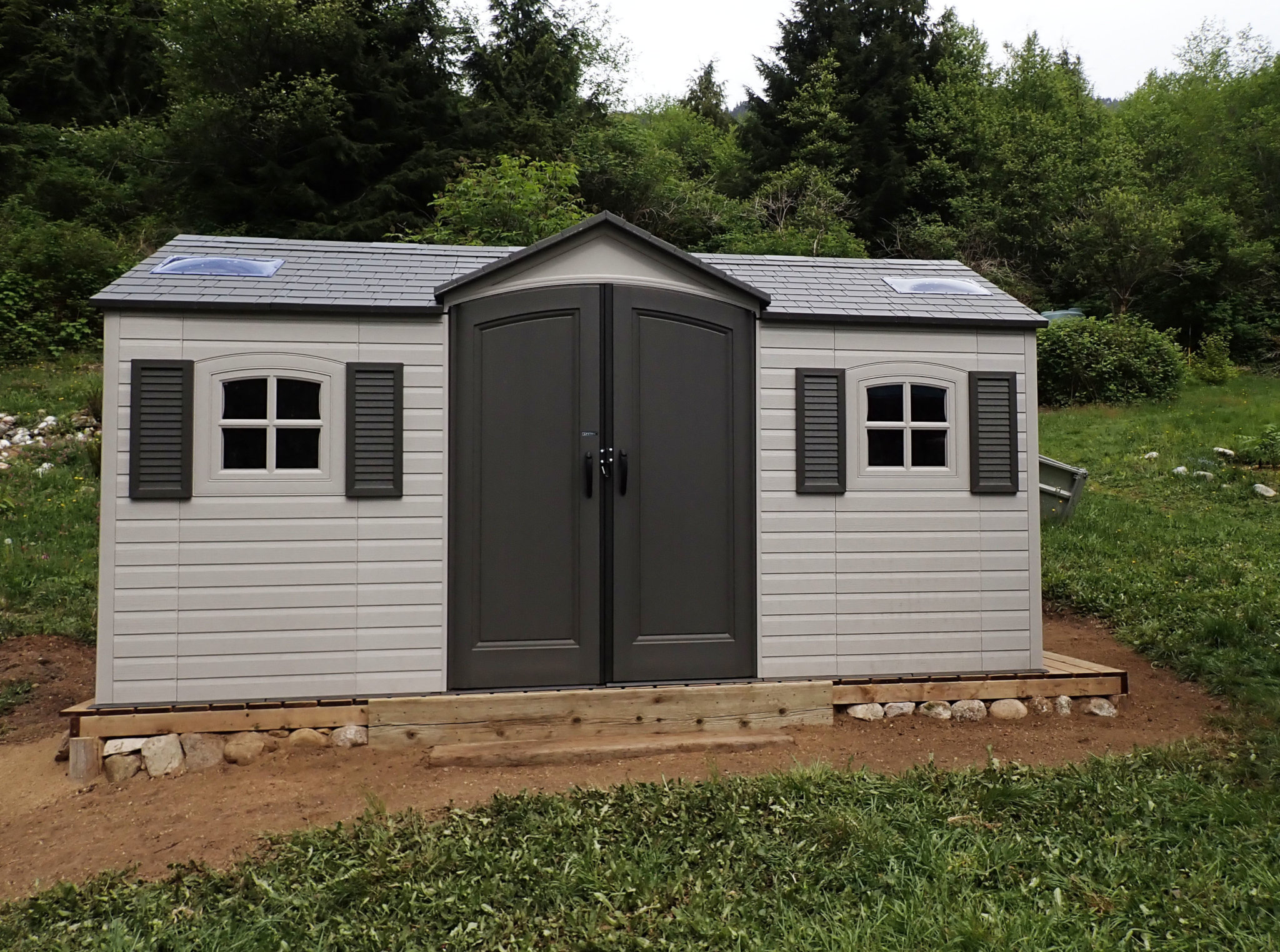
Finally, two days of neither too windy nor too wet weather gave us our break for getting the shed assembled. It was actually quite fun! We felt a real sense of accomplishment as the shed came together like a gigantic Lego project. Since we’ve gotten it up, there has been a windstorm and some heavy rain, and it has neither blown away nor leaked, so we are very happy with it! It’s also been very timely, as our old ShelterLogic tent has pretty much disintegrated, and is largely a heap of tarps tied together. Now comes the tedious work of sorting through all the stuff in the old sheds and transferring the worthwhile bits to the new one. Later, this fall, we will assemble the second shed after the ShelterLogic tent has been taken down.
In Between Things
We managed to get our selected firewood trees dropped in April, thankfully before they had leafed out and the birds had had an opportunity to build nests in them. Ken limbed them and we chipped a bunch of the branches to use as mulch around the garden and orchard, and as cover for our humanure system. Throughout May, Ken cut the wood into rounds, and we split them, filling up the woodshed. It always feels so good to get that job done and know we will be warm and cozy come winter!
Our access road needed brushing back and mowing, and that became a job for June. It took 3 days of hard work with a hedge trimmer to cut back the salmonberry, thimbleberry, and elderberry that was leaning over the road. But it only took 3 hours with the mower attached to the two-wheeled tractor to cut the grass. I just love that little tractor! And the road looks splendid!
We were back into town at the beginning of June, mainly to pick up a pile of orders that we had been accumulating at the Sayward Post Office. There were a few items I was definitely looking forward to—a small pressure cooker to replace my old one (which had a seal that can no longer be replaced), a steam juicer (looking forward to testing that out on our blackberries this summer), and a new (way too expensive) computer.
Things were going great until the very end of our trip. We store our vehicle at a friend’s place, about 3 km from the dock, for security and to keep it away from the corrosive salt spray. When we dropped the vehicle off, I put the key fob in a (supposedly) secure pocket, grabbed Brennan’s leash, and we headed off on foot back to the dock. Just outside the log sort, about a km from the dock, Brennan lunged on his leash, dragging me off balance for a moment. I didn’t think too much about it, and quickly got everything under control. However, when we got back to the boat and I unloaded my pockets, the key fob was missing. I figured it must have fallen out of my pocket somehow when I was dealing with the leash.
We walked all the way back to our friend’s place looking for that darn key fob … it wasn’t where I thought it might be, and it wasn’t anywhere else. We ended up going home without it, and I figured I would have to buy a new one to replace it. Well … new ones are super expensive ($500+ from the dealer, less from Amazon), need to have the key cut and the fob programmed, which requires proof of ownership, and so on. What a major pain! As a long shot, I posted a message on Facebook in the local Sayward group, describing where I believed I had lost the fob. As it turned out, the fob had fallen out of my pocket at the log sort entrance just about the time the kids got out of school. One of them saw the fob as they were cycling home and picked it up (which is why we couldn’t find it when we went back to look). Their grandfather saw the fob and matched it up to my “lost and found” message, and we were able to connect. With luck, the darn thing will be waiting for us in our mail box the next time we go to town. What a relief!!
A New Computer
Computers have gone through a few trends in the last 10 or 15 years. When I first arrived at Port Neville Inlet, I was using a 4-core gaming notebook. It was a terrific computer with easily replaceable parts, but required so much power to run that we had to start the genset in order to check the email! Within a year, I was resigned to getting something less power-hungry. I bought a cheap Acer notebook, which was slower than the dead, but fairly light on its power consumption. I used it for quite a few years, and eventually the battery died. At this point, I discovered that the Acer was part of a new computer trend—throw away electronics. I did manage (in an almost destructive way) to install a pseudo-replacement battery (Chinese made and not quite exactly the right one), which more or less worked. Then a couple of my USB ports died. That was four or so years ago. I always try to keep at least two computers in operational condition—my working computer and something that can stand in as a backup. So, it was time for a replacement.
I bought a Microsoft Surface Go 3, which has been a really great computer, very economical, much faster than the old Acer, and tremendously portable. However, like the Acer, it had essentially non-replaceable components (everything is “glued” together, and pretty much self-destructs when you try to take it apart). At this point in time, the old Acer’s pretty much had it, and my little Surface computer was getting old enough that I expect to have battery problems in the near future. Thus, it was once again time to look at buying a new computer.
This time, I was looking for something that could be repaired, with readily available parts. Happily, since I really liked my little Surface computer, Microsoft has made the move to “greener” computers (see SurfaceTip – Home of Microsoft Surface Tips and Tricks and Microsoft Surface Laptop Repair Help: Learn How to Fix It Yourself.). As a result, what I ended up getting was a 13″ Surface Pro for Business Copilot+ PC with an Intel Core Ultra 7 268V processor, which is a highly power-efficient 8-core computer. But I paid the price! Wow, have computers become expensive. In the couple of months that I pondered a new computer, the price of this one went up by $500. Not only that, stock is limited and there are long wait times because of back-orders.
In between mega-projects and working around the yard and garden, I’ve been quite busy setting up the new computer. In addition to going greener and more serviceable, I’ve finally pretty much moved away from commercial software and have loaded the new computer with almost entirely FOSS (Free and Open Source Software). In the last few years, there has been lots of FOSS software released that works on Windows. In fact, Windows 11 is supposed to be going open source pretty soon. The other thing I’ve discovered is that Windows 11 can run WSA (Windows subsystem for Android) and WSL (Windows subsystem for Linux). I have WSA installed on my computer now, which allows me to run all sorts of Android apps on the computer, and it is fast and completely seamless, unlike the other Android emulators that I have used. I haven’t tried WSL yet, but I know the option is available if I want to run Linux on my Windows system. I’ve also been able to easily run ComfyUI and Qwen-image-edit (open source assistive AI, something like a really souped-up version of Photoshop) offline (so I’m not using online AI data centers) on the new computer. This is something that I’d hoped I would be able to do with a more powerful computer, as it is tremendously helpful when cleaning up my artwork. I’m happy, happy!
Hauling out the Awen, or How to Balance a Boat
For the last two years, we’ve been trying to figure out where to haul-out the Awen. We do not use anti-fouling paint (aka “copper paint”) on our boats, and the Awen has not had her bottom painted for at least 15 years. However, every year, we have to scrape the barnacles, mussels, seaweed, and other encrusting life off the hull to keep the boat fuel-efficient. We also clean the propellor and rudder and replace the zincs which protect the boat from electrolysis damage.
The Port Neville dock, where we have done our haul-out for many years, was now likely out of the question. In May, Transport Canada hired a contractor to do a bunch of repair work on the dock and replace the floats. The dock was then sold for $1 to the Tswotsis Band, and has now become a private wharf. I suspect that they will not be eager to have us lean up against the pilings and do our annual scraping, for insurance reasons if nothing else.
We looked into hauling out at Campbell River, but again insurance is a problem. Since the Awen spends most of its time tied up to a private float outside our homestead, we cannot get insurance. Without insurance, we cannot get hauled out. Ack! Another circular knot of logic.
In February, after we transferred the Awen from our old float to our new one, we spent a couple days using the herring skiff and a pair of come-alongs to pull the four anchors that were holding the old float in place. We then towed the old float and its gear to the beach where it could dry out and be worked on. Over the next couple of months, we cleaned up all the rope, chain, anchors, and the float itself (it’s probably many hundreds of pounds lighter now that 10 years of fouling has been scraped off), not sure what we would do with it all, but never willing to waste anything of value. That’s when Ken came up with a great use for the old float.
Although the deck of the old float is pretty rotten, the main frame is still usable, especially as “lily pad” (a float that dries out at low tide). Ken devised a plan to use it to create a haul-out for the Awen. The idea was to anchor it in shallow water, perpendicular to the shore, at a depth that we could bring the Awen in at a high tide, and then allow the boat and float to settle on the beach. Some additional “guy” lines to anchors on each side would help keep the boat stable and upright on its keel.
Ken rigged up a new anchoring system for the float—lines from a tree and a buried “tail-hold” anchor at the desired location along our beachfront. Then we needed to move the float from the “work beach”, where we had cleaned it, to its new location, the “haul-out beach”. In June, when the tides were right, we set out to do this. Right, of course, is subjective. It was around 11:00 pm, dark, with a bear in attendance. We were going to tow the float with our herring skiff. However, the skiff’s engine wouldn’t start. OK, we were going to pole the float along the beach in the dark. Well, that sort of worked in that we got the float into deeper water where we could anchor it and figure out the engine problem later. The next day, the herring skiff’s engine started just fine (I guess it doesn’t like to run in the dark), and we managed to get the float towed into place. We spent a couple more days burying two other anchors, one on each side of the float, and setting up support ropes.
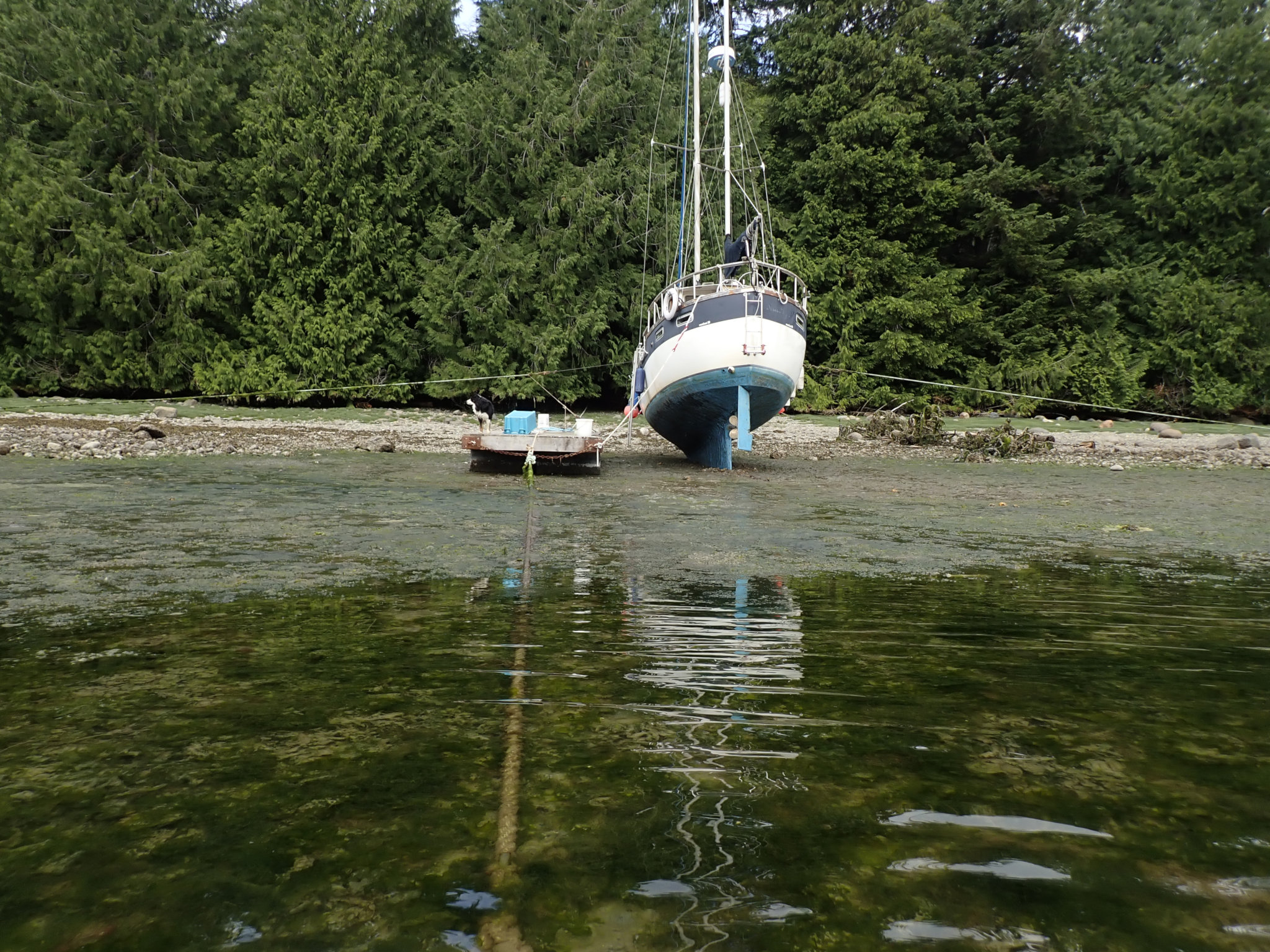
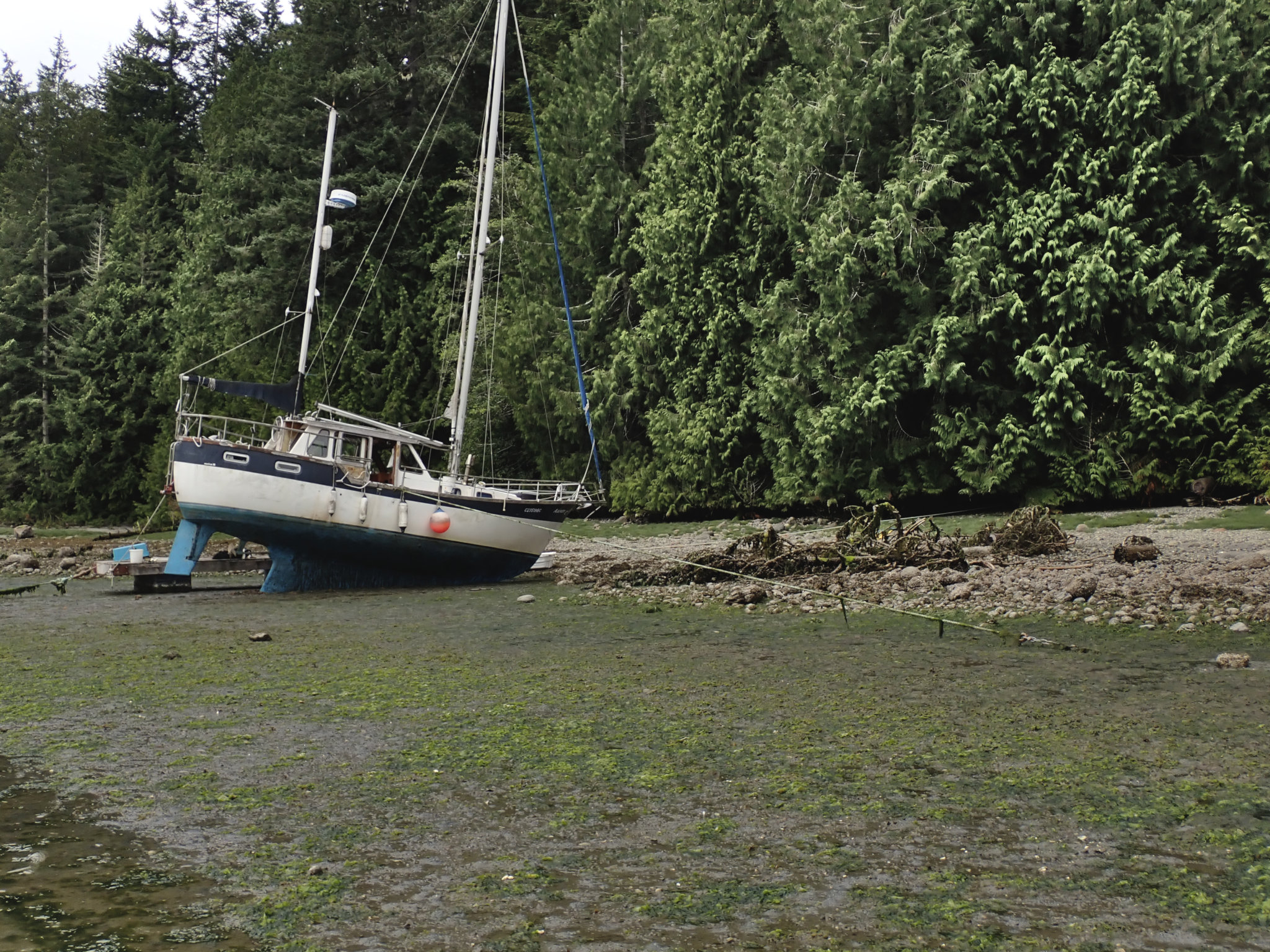
At the beginning of July, we finally got the right combination of tides, wind, and weather to try out our new haul-out scheme for the Awen. We were pretty nervous about the whole adventure, but it went incredible smoothly and we were impressed by how easily the old boat balances on her keel. By early afternoon, we had her hull scraped, her propellor polished, and her zincs replaced. Here are a couple of pictures (no before photos, as the hull was embarrassingly fouled):