So, to tell a little more of my story …
I was born a farmer’s daughter in the small town of Lillooet, BC. I spent my first seven years on a cattle ranch where our cows grazed on mountain slopes while the Fraser River flowed languorously through its valley far below. Then my family moved to Alberta, where they farmed cattle in the foothills of the Rocky Mountains, raising Angus cows fattened on grain grown and harvested on the farm. Fast forward a few more years, and we were now living in orchard country, growing apples, plums, and peaches beside the Similkameen River. Farming is in my blood. I come by my desire to live on the land naturally.
Succession was once the norm—the handing down of the land from parents to children, to be stewarded by the younger generation in their turn. Homesteading was once a way of life—not industrial agriculture as we understand it now, where the sole purpose of cultivating the land is to generate a profit, but rather a gentler, more sustainable approach where the people cared for the land and the land fed the people. Now, not so much. My father grew up as the product of generations of farmers where succession was always passed to a son. After all, in British Columbia, women have only been able to own property since 1964, a bare two years before I was born. There were no sons in our family to inherit the land. Furthermore, like many farmers of his generation, my father only perceived the land as wealth—his wealth, which would one day be his retirement income. So, succession was not mine to be had. I moved on, got a career, got a job, had many great adventures, but still felt the longing to return to the land.
My partner and I were lucky. We were able to purchase a piece of land before the prices skyrocketed, and land became largely unaffordable to most people. In the eleven years since, we have grown roots and settled in, and learned to live in synchronicity with the seasons. Sadly, as we became more committed stewards of our land, the community around us began to decline.
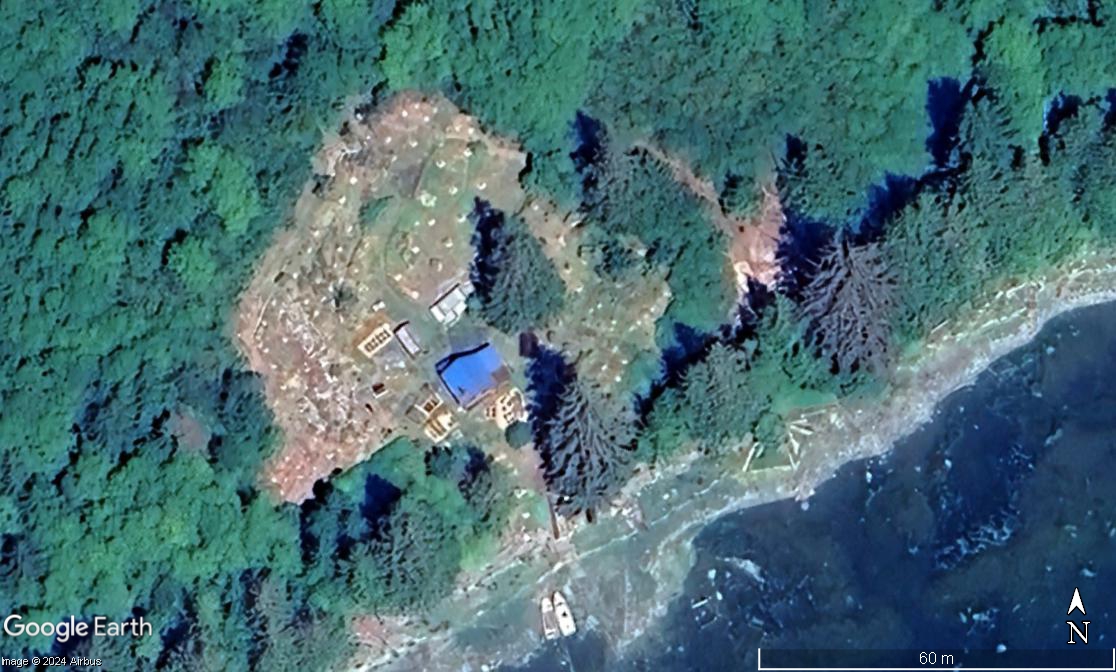
“What is our land like?” That is a question we are often asked. We have fifty acres of ocean front land eight miles up Port Neville Inlet. Our property is zoned silviculture, and has been logged for large timber back in the early 1900s, then clear cut about 30 years ago. It was not replanted, and is now naturally regenerating, mostly in alder at this stage. Originally, there was an old homestead on the property (early 1900s) that encompassed about ten acres of the fifty. Currently, our zoning allows us to have two houses on the property (e.g., two “families”), with no possibility of subdividing. We don’t have any real issues with the zoning … two families on fifty acres is just about right for a level of sustainability that allows a significant proportion of the land to be set aside as an “ecological reserve” (e.g., to keep the environment healthy and not abuse the land and its resources).
The lower ten acres of our land is marginally arable, composed mainly of rocky, silty soil on relatively steep slopes, and is subject to erosion in the heavy winter rains. However, with a gentle hand, the land will produce a yield, especially when working with practices such as perennial food forestry, agroforestry, non-timber forestry product harvesting, wild foraging, permaculture, and rewilding. Having said that, our land cannot support intensive agriculture, since the soil fertility rapidly depletes, followed by erosion, leaving nothing but little stones behind. We’ve lived here long enough to learn by experimentation!!
The upper forty acres is steep and heavily forested. We have been intentionally leaving this portion to recover and rewild. We believe the land could sustainably support two families (e.g., maybe ten or so people), but not much more than that. We also believe that retaining large amounts of land in their “wild” and treed state is absolutely vital to combating the current situation of climate change and keeping our supporting ecosystems healthy and viable. So, the ten acres under agriculture to forty acres left wild works well for us in an ecological sense.
Our beach is a mixture of sand, cobble, and mud. While not an “exotic” white sand beach, it is home to a great diversity of marine life, including many species of shellfish, such as cockles, clams, geoducks, and crabs. Five species of salmon swim up the Inlet to Fulmore Lake, and many types of waterfowl spend their winters in the Inlet’s calm waters. Deer and elk graze on our land, and keystone predators are supported by the surrounding ecosystem.
“What is the Port Neville community like?” This is another question that many people have asked us. In the absence of large sections of flat and highly productive farmland, the original community in Port Neville Inlet was quite spread out, composed of roughly 200 people in a number of small homesteads and two regions of slightly higher density “town sites”.
Sadly, the community in Port Neville has been in decline for many years, as has been happening in a number of small communities throughout Canada. I’ve spent some time pondering the issues that face these villages and homestead, especially the ones that I am familiar with. There seems to me to be two intertwined forces at work. The first issue is attrition, the bleeding away of community members, both young and old. Elders leave for health reasons. Young people leave because they want adventure, or see no hopes of a life or a career in their home community. Eventually the community shrinks to a size that is no longer sustainable, and finally just vanishes from the map. The second issue is the loss of vision, leading to a lack of resilience and an ability to adapt. These communities need to revision themselves in order to revitalize and recreate their purpose, to find their place in the world. Ultimately, if they could do that, people would no longer leave their home communities, but would find meaningful and fulfilling lives within the structure of the community.
Over the past fifty or so years, most of the homestead sites in Port Neville have reverted back to crown ownership as people have left and taxes remained unpaid, thus they are no longer available on the market. With land claims and commercial interests, I’m not sure if any of these crown properties will ever become available to more than a very limited number of people—mostly those who are not interested in living on the land, only in using it as a “resource”. During the past ten years, Port Neville has become a “ghost town”. The majority of the remaining private properties are currently being held by absentee landowners, some from Alberta, some from the US, and a few from BC. These people visit their properties rarely, and do not participate in any “community” activities.
As the last remaining full time residents in Port Neville Inlet, it might seem that the best solution for us would be to sell our remote homestead to someone with plenty of money, and use the profit to buy land which is closer to services, accessible by road, and near some sort of community. Unfortunately, the qualities which make our land unique, and which we love so much, cannot be replaced, dollar-for-dollar and value-for-value by a property that is, for example, five miles from Campbell River. If we could have bought fifty acres of land with road access and a nearby marina for our boat using the money we had ten years ago (back when properties were much cheaper than they are today), we would have. It was not possible then, and even less so now, even with the profit we might make by selling our current property.
However, we have not given up the hope of re-envisioning our community. We totally understand that we cannot recreate the community that was once here. Those days are gone—the access to the land is gone, the steamships that used to service the community are gone, the people are gone. However, we know historically that people could live in small villages and homesteads on this coast, and be happy. Small communities (of the size fifty to two hundred people) were once quite common on this coast, and isolated homesteads were also the norm. You can find the remains of these homesteads all over the coast (and I have visited quite a few over the years). Small indigenous summer camps and “micro-villages” (less than fifty people) were also quite common. These smaller clusters of humanity survived, not by growing, but by interacting with each other and the larger communities to which they were closest. One might visualize this like a web of connections (a “food web”, if you like). This is what we are trying to recreate. At the moment, our hopes are largely to get as many people back into the Inlet as we can, whether through purchase of the remaining private lots, in sharing arrangements with folks like us, or as “live in” caretakers for the properties now owned by absentee foreign owners (and which are quickly falling to ruin through lack of maintenance and stewardship). We would be very happy just to see the old homesteads that were active ten years ago become active again. At that time, we had a healthy set of connections going where neighbors helped neighbors, and we would like to see that here again.
We strongly support the concept of a “network of villages”. We’ve been in touch with several other Vancouver Island initiatives for “intentional communities”, not because we wish to join their communities, but because we want to make connections that can allow us to share ideas, resources, services, etc. We need that to survive what will be coming … there is change in the air, and our current sociopolitical environment is slowly eroding. Connections make for resilience, something that will help us cope with an uncertain future.
One of the issues facing us in the future is the process of aging on our homestead. We are totally committed to what we are doing here. Whether we find someone to take over the stewardship of our land when we pass or not, whether we have assistance or not, we have chosen to “age in place”. For us, this is not a discussion point. We are not interested in returning to the city (been there, done that). However, aging in place is a challenge in our location. We are sixteen miles by boat from Sayward, so getting in and out of town can be something of a hassle, particularly in bad weather. In spite of this, historically, many elders living in the region often achieved ages of 80 to 90 years or more. That being said, if an emergency does come up, Coast Guard can deliver a person to the Campbell River hospital in less than forty minutes. A reasonably healthy person has nothing to fear in the life that we lead. However, a person requiring extensive medical intervention on a regular basis (e.g., dialysis, oxygen) is not going to be able to survive in a remote location like ours. Most elders these days leave their homesteads not because they are currently suffering health issues, but because they fear the possibility of having a serious health problem and not having any assistance … which is why having a supportive community around our elders is so important in enabling them to age in place. At the same time, elders who wish to age in place must develop the capacity to face death, which comes to us all in time, with grace and acceptance. This is something our current society does extremely poorly, and the push for life extension technology at the loss of quality of life is hard to fight against. We need to learn how to go gently amongst family and friends. Quality of life is far, far more important than quantity. As an aside, many of the elders I have know who leave their rural homes to move to the city where there is “immediate” medical assistance do not live long lives, often passing within a couple of years. The stress of no longer being “at home” takes its toll.
Given the remoteness of our location and the declining community, people have asked us “Why would anyone want to live there?” I’m going to address that shortly. However, it’s worth noting that in the six or so years that we have been trying to get a person(s) to share our land with us, we have had numerous people, many of whom were definitely like-minded, and some of whom I still communicate with regularly, who would have happily joined us if they could. Sadly, most of these people were responsible enough to realize that they had commitments (to family, community, property, jobs, etc.) that prevented them from making the “break” and taking us up on our offer. Of course, we’ve also had a number of people approach us who were clearly unsuitable, largely due to addictions, health problems, instabilities, and personal crises. Many people think that by jumping from a troubled situation into a new, fresh situation, they can leave all their problems behind. Unfortunately, that seldom works. So … our problem is not so much finding the right person as it is finding the right person at the right stage in their life for making a big transition.
So, why would someone come to our homestead?
-
- To truly experience nature. You need to be at least ten to fifteen miles away from concentrated clusters of humanity to find ecosystems that are viable and still supporting their keystone predators (e.g., wolves, bears, cougars). This may be frightening to some, but other people very much desire this type of environment.
- To be able to hunt, fish, and forage. This is related to my first point … without a reasonably intact ecosystem, these options are not available.
- To seek a simpler life. A number of the people that I have connected with are looking for a lifestyle that comes closer to the way our ancestors once lived. While I don’t think that we can truly recreate the ancient ways, there are many healthy activities that were once done by small communities and family groups which could be “reinvented”.
- To be able to grow crops and raise livestock for self sustainability. More and more farm land is being overrun by urban sprawl. People have to seek land further and further away from urban centers in order to be allowed to engage in these activities. While our land is not suitable for intensive agriculture (and by this I am referring to “industrial agriculture” where massive inputs are necessary to keep the land productive), it is suitable for permaculture and food forestry practices, which are very definitely sustainable in the long term.
- To have greater freedom. Living on our remote land, we are subject to less rules, bylaws, etc. than we would be if we lived in the city. Furthermore, the regional district is very relaxed about the rules that do exist, allowing people to carry out reasonable and responsible activities, so long as there are no complaints from their neighbors. I am something of a social anarchist in that I believe community responsibility should be balanced by individual freedoms. Too many rules are frequently inflexible and restrictive … a better approach is to look at the situational context of each issue, possibly through a community “circle”, and use restorative justice to correct any wrongs that have been done.
- To have greater safety and security. Personally, I think harder times are coming. I believe that whatever does come down the tube, it will strike the cities much harder than rural areas. Cities are extremely susceptible to interruptions in their supply lines. Most people living in urban congregations seldom have more than a couple days of food on hand. I once had an opportunity to watch how quickly things start to come apart while living in Prince Rupert and having the main highway and train line cut off by a slide that took over a week to clear. By the end of that week, stores were empty, and they had to bring in supplies by barge (thankfully, Prince Rupert had marine delivery as an option). When people get hungry, they often become dangerous, with stronger individuals attempting to take food (and other necessities) from weaker individuals (fortunately, we did not reach this level of barbarism in Prince Rupert, but it has happened in other parts of the world quite frequently). Living on the homestead provides both safety (our 16 miles by boat means that we are relatively safe from “raiders”) and encourages us to keep large stores of food and other supplies (we are probably good for six months or so, at least). The options to fish, hunt, and forage provide further levels of food security.
- To experience greater spirituality. A number of religions and spiritual pathways encourage seeking connections to nature and a simpler life in order to achieve greater spiritual growth and enlightenment.
- To enjoy the diversity of activities and joys associated with a lifestyle that accesses both the ocean and the land. What’s not to love about this, eh?
- To get away from the “madding crowd”, as the saying goes. Living close to nature in a remote environment largely frees us from the “rat race” of today’s society, and provides us with feelings of peace and relaxation.
So, the reasons for homesteading away from the cities are many and varied. Each person who lives in small remote communities has their own set of experiences, values, and purposes which bring them to those communities, and which keeps them there. We are hoping to find like-minded people who can share our home and our world view.
If this article touches you, please share it around!